Your Exclusive 10% Gift Awaits
Enjoy 10% off your order—our way of saying welcome! Use code PROHEALTH42 at checkout to unlock instant savings and start exploring our collection today.

$85.00
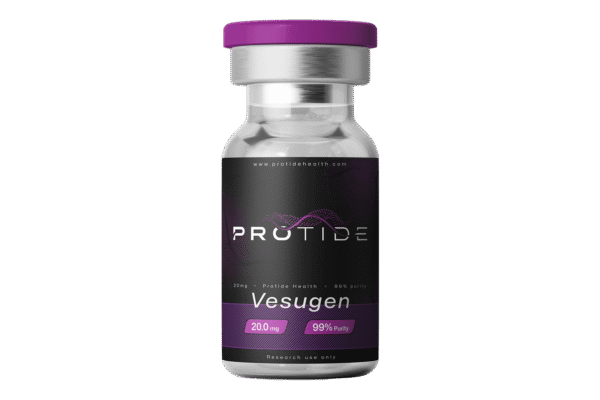
Vesugen peptide studied in preclinical vascular endothelial proliferation and epigenetic regulation models. Available in 20mg lyophilized vials. Third-party tested, 99% purity. For research use only. Not for human consumption.
Vesugen 20mg is a synthetic tripeptide bioregulator designed strictly for laboratory investigation. Researchers evaluate this compound in preclinical models to explore its interaction with cellular signaling and specific vascular pathways. This article provides a comprehensive overview of its structural characteristics and in vitro mechanisms.
In vitro studies focus on this tripeptide sequence, denoted as Lys-Glu-Asp (or KED). Laboratory investigation categorizes it as a cytogen, synthesized to mimic specific protein sequences found in cellular vascular tissues.
Researchers utilize this short-chain compound to evaluate rapid cellular absorption in isolated tissue models. The tripeptide structure allows researchers to measure basic peptide-DNA interactions without the variables introduced by longer molecular chains.
Preclinical models evaluate:
The specific Lys-Glu-Asp sequence characteristics
Protein synthesis metrics in simulated vessel walls
Molecular stability in diverse in vitro environments
Current research investigates specific cellular responses associated with this compound. Animal studies measure the tripeptide’s capacity to influence gene expression and structural pathways within vascular endothelial cells.
Laboratory investigation examines the compound’s proposed interaction with cellular DNA, specifically measuring interactions at promoter regions like MKI67 (PubMed). Molecular docking studies measure the peptide’s ability to bind to specific CATC motifs within the DNA minor groove.
Studies investigate:
Ki-67 expression (a marker for cell proliferation)
Endothelial cell division metrics in isolated cultures
Simulation of cellular repair and regeneration pathways
Preclinical models measure how Vesugen influences structural adaptations following induced stress. Researchers observe related changes in specific inflammatory and energy markers.
Observations in these models include:
Modulation of vascular endothelial growth factor (VEGF) signaling
SIRT1 activation metrics related to cellular longevity pathways
Interactions with the AMPK energy sensor pathway
To learn more about analyzing similar cellular mechanisms, consult our peptide guides.
Experimental applications strictly focus on measuring specific biomarkers related to vascular elasticity and microcirculation. Researchers utilize these models to understand fundamental cellular adaptations.
Animal studies examine structural responses following induced ischemic events (restricted blood supply). In vitro studies measure changes in endothelial cell cultures isolated from varying age models to understand cellular longevity mechanisms (PubMed).
Evaluations focus on:
Measured decreases in pro-inflammatory markers within vascular tissues
Changes in dendritic spine structures in neurological models
Endothelial proliferation rates in aging cellular models
To explore our full inventory of synthetic tripeptides, visit our research peptides catalog.
Researchers often analyze structurally related compounds to map specific sequence responses across targeted cellular environments.
Research examines its interaction with specific DNA sequences in controlled settings. Animal studies measure its influence on endothelial cell proliferation and vascular repair mechanisms.
In conclusion, Vesugen 20mg remains a significant focus of laboratory investigation regarding epigenetic regulation and vascular endothelial cellular pathways. Preclinical models continue to examine its interaction with specific gene promoters and proliferation markers.
Khavinson, V. K., et al. Advances in Gerontology. PubMed
Tarnovskaya, S. I., et al. Advances in Gerontology. PubMed
Umnov, R. S., et al. Bulletin of Experimental Biology and Medicine. PubMed
The information provided in this description is for research purposes only. The Vesugen peptide is not approved by the U.S. Food and Drug Administration (FDA) or any regulatory authority for human consumption or therapeutic use. It is intended solely for investigational use in controlled laboratory settings by qualified researchers. Protide Health does not endorse or promote the use of Vesugen peptide in humans or animals outside of approved research protocols. Researchers must comply with all applicable local, state, and federal regulations, including obtaining necessary approvals for experimental use. Consult with regulatory authorities before initiating any research involving Vesugen peptide.
Products sold by Protide Health are for laboratory research purposes only and are not intended for human consumption, medical use, or veterinary use.
Reviews
There are no reviews yet.