Your Exclusive 10% Gift Awaits
Enjoy 10% off your order—our way of saying welcome! Use code PROHEALTH42 at checkout to unlock instant savings and start exploring our collection today.

Price range: $95.00 through $155.00
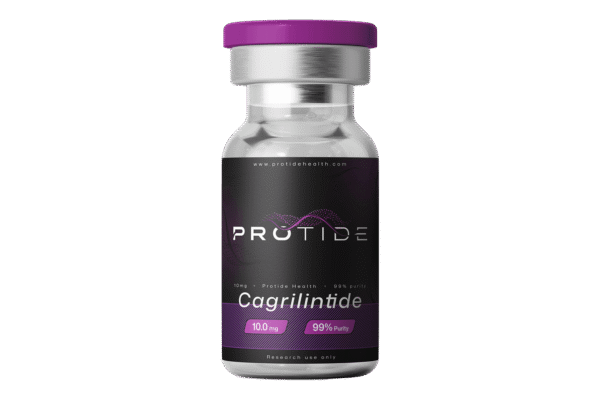
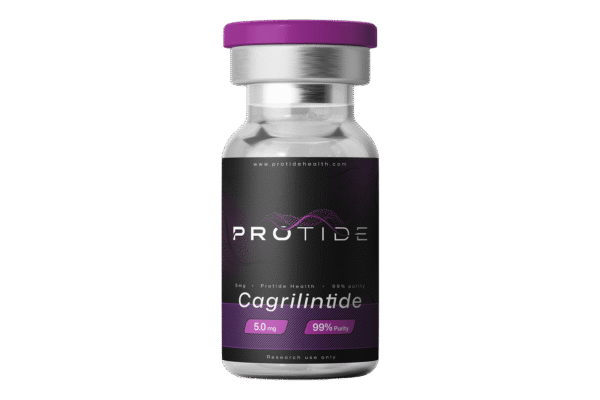
Cagrilintide is a lab-tested long-acting amylin analogue peptide studied for metabolic research. Non-selective agonist of amylin and calcitonin receptors. Available in lyophilized vials in 5mg or 10mg. Purity >99% verified by third-party HPLC testing. USA domestic fulfillment. For research use only. Not for human consumption.
Cagrilintide is a synthetic long-acting amylin analogue developed strictly for laboratory investigation. Researchers utilize Cagrilintide 5mg and 10mg vials in preclinical models to explore its influence on metabolic signaling and energy expenditure pathways. This article details the molecular characteristics and observed mechanisms of this research compound.
In vitro studies focus on the specific structural modifications of this 37-amino-acid synthetic peptide. Research examines how it interacts with cellular targets in controlled environments.
Cagrilintide features a molecular weight of approximately 4409 g/mol. Preclinical models evaluate its N-terminal lipidation (the addition of a lipid chain), which researchers hypothesize enhances structural stability.
Laboratory investigation measures:
Disulfide bridge integrity between specific amino acids (Cys3 and Cys8)
Resistance to enzymatic degradation in cellular assays
Binding affinity to specific transport proteins
Current research investigates specific cellular responses associated with this compound. Animal studies measure its role as a dual agonist (activator) at specific neuroendocrine receptors.
Laboratory investigation examines how the peptide influences amylin receptors (AMYR) and calcitonin G protein-coupled receptors (CTR) (PubMed). In vitro models evaluate its capacity to modulate intracellular signaling cascades.
Studies investigate:
Cyclic AMP (cAMP) production levels in AMYR-expressing cell lines
Neuronal activation markers in isolated hypothalamic regions
Receptor binding kinetics in controlled testing environments
Experimental applications strictly focus on measuring biomarkers during induced physiological states. Researchers use rodent models to map metabolic homeostasis (the balance of energy pathways).
Animal studies measure specific physiological responses following receptor activation. Researchers evaluate changes in gastric emptying rates (how fast the stomach empties) and related satiety signaling (PubMed).
Observations in these models include:
Measured modulation of feeding behavior metrics in subject models
Fasting glucose level fluctuations in experimental models
Synergistic pathway interactions when combined with GLP-1 receptor agonists (PubMed)
Explore our full inventory of laboratory compounds, including the 5mg and 10mg formats, in our research peptides catalog.
Researchers often analyze structurally related peptides to map varying receptor affinities and pharmacokinetic profiles across different testing subjects.
Research examines its interaction with AMYR and CTR in controlled settings. Animal studies measure its influence on metabolic pathways and satiety signaling biomarkers.
Preclinical models investigate the N-terminal lipidation to determine its impact on enzymatic resistance and prolonged stability compared to endogenous peptides.
In conclusion, Cagrilintide remains an important subject of laboratory investigation regarding amylin receptor activation and metabolic regulation. Preclinical models continue to explore its mechanisms within neuroendocrine signaling pathways.
Kruse, T., et al. AM833 Receptor Agonism. PubMed
Enebo, J., et al. Cagrilintide Weight Management Models. PubMed
Frias, J. P., et al. CagriSema Trial and GLP-1 Agonists. PubMed
Hay, D. L., et al. Amylin Neuroendocrine Research. PubMed
The information provided in this description is for research purposes only. The Cagrilintide peptide is not approved by the U.S. Food and Drug Administration (FDA) or any regulatory authority for human consumption or therapeutic use. It is intended solely for investigational use in controlled laboratory settings by qualified researchers. Protide Health does not endorse or promote the use of Cagrilintide peptide in humans or animals outside of approved research protocols. Researchers must comply with all applicable local, state, and federal regulations, including obtaining necessary approvals for experimental use. Consult with regulatory authorities before initiating any research involving Cagrilintide peptide.
Products sold by Protide Health are for laboratory research purposes only and are not intended for human consumption, medical use, or veterinary use.
| Select vial strength: | 10mg, 5mg |
|---|
Reviews
There are no reviews yet.